Nature of the 21st Century Learner
As the world continues its rapid expansion into the 'digital age', the role of technology plays a significant part in the lives of 21st Century Learners. The world in which these learners inhabit differs to those of previous generations. Exposure, from an early age, to computers and the internet, videogames, digital musical players, mobile phones and other modes of technology has resulted in today's learner acquiring and applying knowledge in fundamentally different ways.
Prensky (2001) describes 21st Century Learners as "Digital Natives"; students whose learning and experiences are shaped by their immediate digital environment. Through the various digital technologies on offer, today’s children are exposed to alternative methods of learning via informal educational environments, for example websites, which aim to encourage and facilitate reading in the lower primary grades. Keeping this in mind, it can be concluded that today’s learners require a combination of both traditional and modern methods of formal educational instruction to promote curiosity and nurture a commitment to lifelong learning. To successfully accommodate the needs and expectations of the 21st Century Learner, educational methods must be relevant; teachers should ask themselves: How can I best prepare each individual student for the world that awaits them? What methods of instruction are most relevant to 21st Century Learners?
(Linnicmommy, 2010)
Education and the 21st Century Learner
Given that teachers have the ability to make an enormous positive contribution in the lives of children (Shelly, Gunter & Gunter, 2010); effective educational experiences must be provided, to ensure that today’s learners are equipped with the knowledge that will prepare them for the real world.
Various modes of educational instruction currently exist; traditional methods, those in which the learning environment was predominantly 'teacher-directed', now exist alongside more 'student centred' approaches. Originally, the focus was on 'teaching', now it is on 'learning'.
Cognitive Learning Theory refers to the process of learning by explaining how knowledge is acquired and organised (Eggen & Kauchak, 2010, p. 196). The following principles apply to Cognitive Learning Theory:
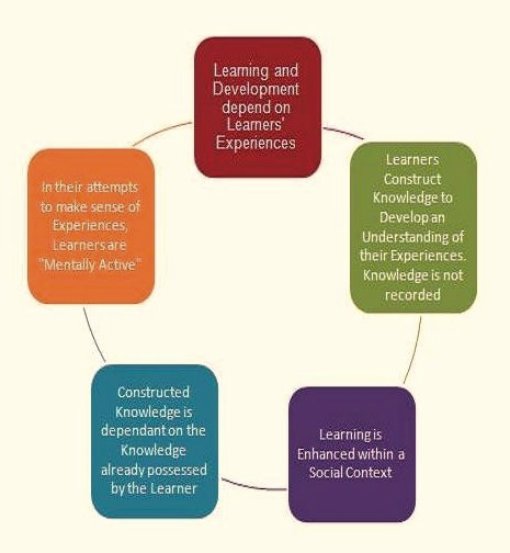
Adapted from Eggen & Kauchak (2010 p. 196-7)
It is evident that this theory is relevant to 21st Century Learners. The importance of knowledge gained through social, collaborative and “technology rich” learning environments (Shelly, Gunter & Gunter, 2010, pg. 293), will equip today’s learner with the resilience to face life’s challenges.
A Constructivist Approach to Learning
'Constructivism' (Eggen & Kauchak, 2010, p. 226), refers to the theory that learners create their own knowledge of topics. 'Social Constructivism' refers to the process in which learners first construct knowledge in a social context and then individually internalise this information (Eggen & Kauchak, 2010, p. 227). This would suggest that 21st Century Learners work more effectively within social learning groups that are 'scaffolded' by the teacher and other students.
Today’s learner prefers learning that is useful and relevant to the world. A 'hands on' approach to learning within a socially constructive environment is preferable to an environment where information is purely transmitted by the teacher. Relying solely on lecture based instruction is not an effective tool for the visual world in which today’s learner inhabits.

(Constructivist1, 2010)
The way in which 21st Century Learners view, interact and communicate with their environment differs from previous generations due to the technological nature of the world. (Shelly, Gunter & Gunter, 2010, p.15). As a result, teachers must be willing to embrace current and emerging technologies and incorporate these into their lesson plans. They must also be willing to be 'the learner'.
Motivation and the 21st Century Learner
Utilising a variety of effective learning techniques within the classroom will ensure that focus and attention is retained. What strategies could be used to eliminate boredom and excite today’s learners?
Prensky (2001) has suggested that “digital natives” prefer processing information in the form of pictures, sounds and video before text. He also commented that these students prefer learning that is instantly useful and fun. Incorporating technology with traditional learning methods can assist in promoting creativity and enhance motivation. The 21st Century Learner must feel that acquired knowledge is relevant. The content of the learning material need not change; offering alternative methods of presenting the content will motivate today’s learner.
McDevitt & Ormrod (2010, p. 497) suggest that allowing students to become physically involved with a topic, for example, through role play or experimentation, will promote 'intrinsic motivation'. Intrinsic motivation refers to the way in which learners are involved in activities and learning for its own sake; they do not seek external rewards (Eggen & Kauckak, 2010, p.285).
Collaborative involvement has been shown to increase learner motivation and interest. Other strategies which are useful in promoting intrinsic motivation include:
· Presenting challenges to the learner
· Promoting learner’s feelings of autonomy
· Evoking curiosity through novel learning experiences
· Involving creativity and imagination in learning methods
(Eggen & Kauchak, 2010, p. 285)
Regardless of which teaching methods are used, it is important to remember that the 21st Century Learner requires a stimulating learning environment, in which learners are encouraged and supported through their personal growth.
Conclusion
In the past children went to school, sat at a desk and were instructed to by the teacher. Today’s learner is exposed to a variety of learning techniques, which aim to promote a sense of belonging. Emerging technology will continue to influence the way in which the curriculum is delivered. Traditional methods will continue to be utilised by today's learner; teaching beginning reading in lower primary grades, for instance, will still require the use of readers. However, the difference with 21st Century Learning is that technological practices need to exist alongside traditional methods to offer the best possible learning outcomes for the 21st Century Learner.
Written by Gina Makris