One theme, two different approaches...by Gina Makris
Scenario 1:
Primary School, Grade 5
Teacher: “For your homework tonight, you will be preparing a speech on birds. Tomorrow, I will be asking you to make your speech in front of the class. Today, you will read this text quietly to yourselves in preparation for your speech”.
Scenario 2:
Primary school, Grade 5
Teacher: "In today’s lesson we will be focussing on birds. The internet will be used to conduct research into the way birds have adapted within their environment. Tomorrow, I have organised a short excursion in order for you to observe birds in their natural habitat. Once we arrive back in class, we will discuss our findings as a group"
The first scenario is a memory I have from my own schooling. I recall being petrified of the prospect of making a speech in front of the class and was unable to concentrate on the text.
The second scenario is how a teacher may approach the lesson within a 21st Century classroom. Providing authentic learning opportunities within a supportive classroom environment enables students to be enthusiastic participants in their learning.
This is the type of teacher I strive to be.
Selecting the Leaders of Tomorrow
Written by Adam Lesniak
A few months ago, I discovered a passage, which had a profound impact on my perception of the world. It was a passage written by Charles Darwin (1859), which was cited by Richard Dawkins (2009, p. 64) in his book The Greatest Show on Earth:
It may be said that natural selection is daily and hourly scrutinizing, throughout the world, every variation, even the slightest; rejecting that which is bad, preserving and adding up all that is good; silently and insensible working, whenever and wherever opportunity offers, at the improvement of each organic being in relation to its organic and inorganic conditions of life. We see nothing of these slow changes in progress, until the hand of time has marked the long lapse of ages, and then so imperfect is our view into long past geological ages, that we see only that the forms of life are now different from what they formerly were.
As I think back on my school, I must say that I had mostly great teachers (comparing my experiences with that of others). Furthermore, there were elements of constructivism at my school, in the early 90’s, although, the norm was ‘chalk and talk’, and memorization tactics. Being a B+/A- student, at the time, I felt that I understood most things.
I am 33 now (as of January 2011), and I readily admit that I have forgotten most of the complex material that I once knew as a seventeen year old. Moreover, in some cases, it is as if I never learned it in the first place. This is my evidence for the promotion of constructivism. I was taught to memorize a sequence of steps, not to understand the concept, and thus, as soon as the practice stopped, so did the understanding… back to Darwin.
I intend to keep Darwin’s thought in the front of my mind as I facilitate my students’ learning. This passage reminds me to seize every opportunity; to continue to develop, technically and professionally; and to prepare students for the ‘real world’, by providing concrete, real world examples, scaffolding their evolution.
I am committed to continuing my education, remastering what I once knew, and sharing my life experience in a way that will benefit my students. My classroom shall be a mix of proven, traditional and constructivist approaches. I am also mindful of the importance of technology, and shall endeavour to use it in every way possible, allowing students to harmoniously express creativity and understanding.
Classrooms of the Past - Lucy Martic
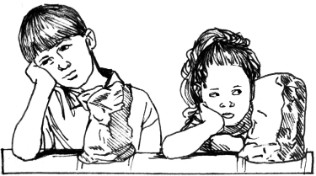
(Bored students, 2006)
As a young child, 30 years ago just starting school, I remember dull classrooms, sitting in rows, not being allowed to talk to the other children and feeling totally bored. I often found myself daydreaming and not listening to what was being said in class. There was a lot of lecturing and quietly reading from texts in middle/high school which was not a learning style that engaged me. I did not feel motivated which made it extremely hard to remain cognitively active long enough to make sense of anything I was memorising. Albert Einstein (1879-1955 German-Swiss-U.S. scientist) once said that: “It is the supreme art of the teacher to awaken joy in creative expression and knowledge”. I believe this to be true as a good teacher can pick up on students’ interests and make even the most challenging material engaging.
Today Classrooms are so lively, colourful and full of excited chatter and If we accept the challenge of becoming teachers we must understand the huge responsibility we have and be committed to each and every one of the students in our care. Let’s make their experiences very different from our own, in a good way!

(rfk_children)
Technology by Klara Lawrence
Good riddance to heavy school bags with 5 text books or more weighing you down. This year my niece’s school has implemented that all students in years 7 and 10 are required to purchase laptops in place of school books. I think this is a fantastic idea. The computer cost is $650, whereas the text books were $1800. A big saving for families and all students are required to have the same laptop. This takes an enormous amount of pressure off parents and students. This enables students to have all information required at their fingertips and the stress of remembering books is gone. There will be no worry about selling text books at the end of year either.
Having students use laptops in their lessons also gives them plenty of experience in computer knowledge. As a result typing speeds will get faster which is an added bonus in every lesson. I remember learning to type on the old typewriter. Having typing under my belt would enable me to have flexibility in my career choice. However little hands on big hard to use stiff typewriters are not an easy lesson and when I finished the term I was not a fluent typist. Had I had the luxury of typing my work on a laptop, not only would I have spent less time ruling up a page, I’d have spent more time listening to the teacher. My resume would have included a great typing speed too.
Traditional Teaching, must stay in the past...by Shereen McNally
I spent the majority of my school years in a private girls grammar school. The school had a reputation of achieving excellent academic results at VCE level. Those students deemed incapable of achieving these results at year 12 were asked to leave at year 10.
This school was focused on the traditional ways of teaching: setting very high standards which all students were required to achieve, aligning curriculums to these standards, constructing assessment to ensure all students were meeting these standards, rewarding students who did achieve and punishing students who did not meet these standards (Brooks & Brooks 1993, p, vii).
In primary school, the majority of subject content was of a very high standard. Algebra formulas had to be memorised for maths, dates, artists and paintings had to be memorised for art history, formulas and equations had to be memorised for science and the list goes on.
Assessment was based on regular tests and semester examinations. At such a young age, I could not cope with the learning content and my parents enrolled me in private tutoring so I could meet the demanding requirements of the school curriculum.
Too much of the curriculum was presented in small disconnected parts. Despite memorising material to pass test or exams and carrying out assigned work, I simply was not learning. I was unable to relate or demonstrate understandings of how these parts related to their wholes (Brooks & Brooks 1993, p, vii).
The effective teacher of today must gravitate towards constructivist principles of teaching simply because...they make sense.
“...remarkable teachers mattered so much because they were less concerned about covering material than they were about helping students connect their ideas with new ones. These teachers recognised that learning is a uniquely idiosyncratic endeavour controlled not by them but by their students, and they knew that conceptual understanding mattered more than test scores. These teachers are constructivist, and they’re the ones we remember.” (Brooks & Brooks 1993, p, xi)
