Piaget and Vygotsky |
||
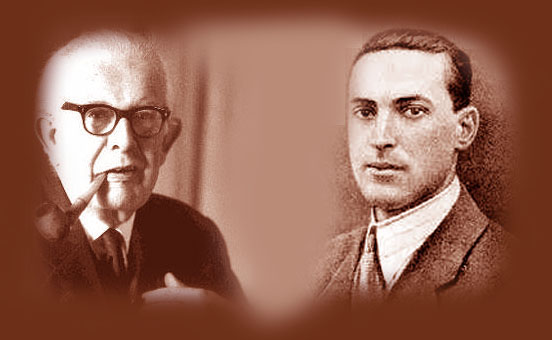 Jean Piaget In the mid 1900’s, Jean Piaget was incredibly influential in the area of developmental psychology. His focus was on young school children, more specifically, how they, individually, constructed knowledge, or made sense, of the world around them. Eggen and Kauchak (2010, p. 43) identify that, considering modern education, Piaget’s work now harbours some shortcomings, although, his research has greatly contributed to the constructivist movement now seen in schools, world wide. Featherston (2006, p. 156) agrees that Piaget’s view of constructivism focuses on the individual, and that cognitive maturation, or development, occurs in four distinct stages: Sensorimotor (0-2 years), Preoperational (2-7), Concrete Operational (7-11), and Formal Operation (11-Adult). McInerney and McInerney (2002, p. 26) cite Case (1992) who offers, “In effect, Piaget viewed the child as a young scientist, constructing ever more powerful theories of the world as a result of applying a set of logical structures in increasing generality and power.” This provides a good insight into Piaget’s theory; however, Vygotsky had a slightly different perspective.
Lev Vygotsky Whereas Piaget focused on the individual, Vygotsky believed that understanding was best constructed in a social environment. Vygotsky propounded that children learn best in a ‘zone of proximal development’—“the stage at which a child’s skills can be developed with the assistance of others” (McInerney & McInerney, 2002, p. 46), and that ‘scaffolded instruction’—“providing guidance that allows the learner to progress through the zone of proximal development” (McInerney & McInerney, 2002, p. 46) were two key elements, in fostering understanding. Discussion with fellow students suggests that Piaget’s and Vygotsky’s principles are harmonious with the ideals of many, soon to be, 21st century teachers. From this evidence, it could be concluded that constructivist approaches will continue to be employed, and developed, well into the 21st century. Written by Adam Lesniak |
||
This free website was made using Yola.
No HTML skills required. Build your website in minutes.
Go to www.yola.com and sign up today!
Make a free website with Yola
